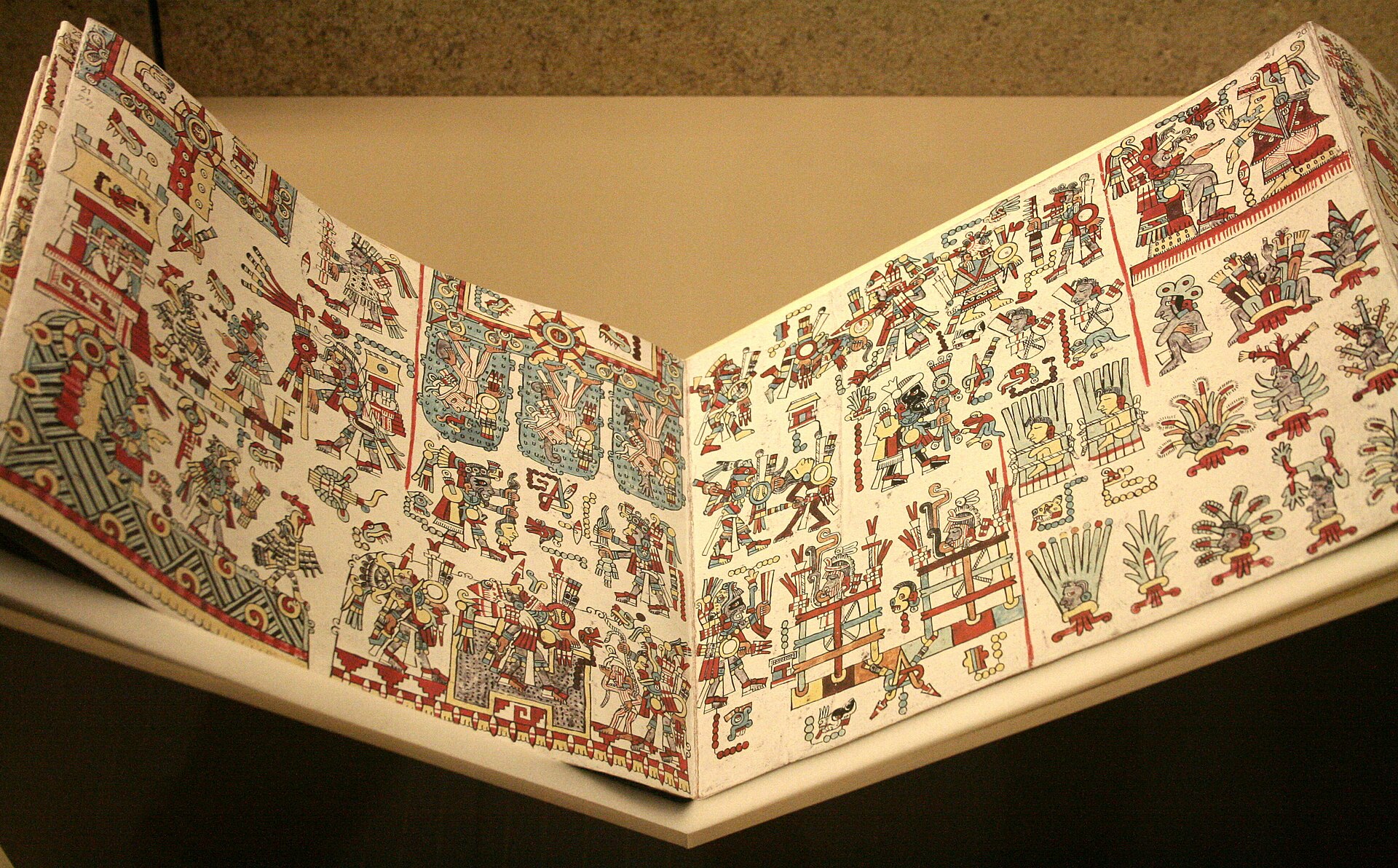
Codex Zouche-Nuttall (source: Michel Wal, GFDL, via Wikimedia Commons)
Week FOur, 9/8/2026
This week, we’re thinking about developing digital collections, and the issues posed by using photos that do not necessarily belong to you. It’s easy to see the connection between these two topics—in order for students to utilize programs like Omeka to create class projects, they often have to pull images and other files from outside sources, like archives and museums. While I was creating my Omeka project as an undergrad, I was lucky enough (or perhaps unlucky enough?) to have photographed and processed all of those images myself, such that our readings which outline scholars’ general anxiety about permissions and images surprised me.

However, an issues report on “Copyright, Permissions, and Fair Use among Visual Artists and the Academic and Museum Visual Arts Communities,” sponsored by CAA, detailed quite convincingly that not only are the majority of scholars anxious about using images, but that this anxiety can really hinder research. The report notes that scholars simply are unaware of how copyright law actually functions, and therefore that their “work is constrained and censored, most powerfully by themselves, because of that confusion and the resulting fear and anxiety.”1 (CAA Report, 7)
Much of the report is spent advocating for the understanding of fair-use images, and images in the public domain. Essentially, while scholars might be worried that they’d face legal repercussions for not gaining permission to use a specific image, oftentimes they are well within their legal right to use said image under fair-use policy. I imagine this is equally, if not moreso, the case for students who create publicly available projects as part of their coursework. In those cases, there’s a clear educational motive behind the use of whichever image.
One such example is the work done by art historian Lauren Kilroy-Ewbank, who began implementing Omeka into her classroom to explore the pre-Columbian Mixtec Codex Zouche-Nuttall.2 In her article, “Doing Digital Art History in a Pre-Columbian Art Survey Class: Creating an Omeka Exhibition Around the Mixtec Codex Zouche-Nuttall,” Kilroy outlines how and why Omeka specifically was her collection-builder of choice for students. The interface is fairly beginner-friendly (though it definitely has its frustrating aspects) and students can organize different pages under one larger exhibition. This means that although each student was learning and writing about the same Codex, they would make their specific page about only one aspect of the codex—say, one specific symbol or theme.
Further, this visually-forward platform allows art history students to equally value images and text as aspects of their scholarship, which is sometimes lost in traditional essays. Kilroy also mentioned that she had an assignment which trained students in DublinCore, the language conventions widely-used by archivists. I thought that not only was this a potentially useful skill for the job market, but also that it’s a great way to get students thinking about some of the fundamentals of art objects. “What is this object made of?” and “what is it used for?” might appear to be an obvious question, but it is essential that we begin with those considerations when we’re discussing art objects.
Finally, in class this week we began to explore CollectionBuilder, an open-source model for creating digital collections using metadata and linked files. Like all good digital art history tools (see Omeka above), CollectionBuilder is free and open to use by the public. A similar model to this can be found in ArchivesSpace, which is also open-source, but is more focused on internal data management rather than user interface, and is most often used by institutions as opposed to individuals. CollectionBuilder finds much of its strength in its relative accessibility, and seems to be most useful for pulling public domain and fair-use files from different sources to be compiled in one exhibit. Another strength of CollectionBuilder is the built-in user interface: it’s simple but effective, and it automatically creates a timeline.
It must be said, however, that the biggest weakness of CollectionBuilder is the fact that it relies heavily on HTML coding. Despite the digital prowess and training that archivists generally have, often those abilities manifest in their use of specific programs like the aforementioned ArchivesSpace, or the popular TheMuseumSystem. Further, us art historians often seem like luddites in comparison to our more computationally-minded colleagues in the archives, meaning that CollectionBuilder’s heavy reliance on code is even more of a barrier to access. While I understand that one cannot ask too much for a free-to-use and communally created software, the fact that users have to navigate code and coding in order to develop a collection makes the software somewhat more inaccessible. Even so, I am excited to start building my own collection using CollectionBuilder, with my fair-use and public domain images of course!
- Patricia Aufderheide, et al. Copyright, Permissions, and Fair Use among Visual Artists and the Academic and Museum Visual Arts Communities: An Issues Report (College Art Association, 2014) ↩︎
- Lauren G. Kilroy-Ewbank, “Doing Digital Art History in a Pre-Columbian Art Survey Class: Creating an Omeka Exhibition Around the Mixtec Codex Zouche-Nuttall,” Journal of Interactive Technology and Pedagogy, no. 12 (February 2018) ↩︎

.jpg)

Leave a Reply